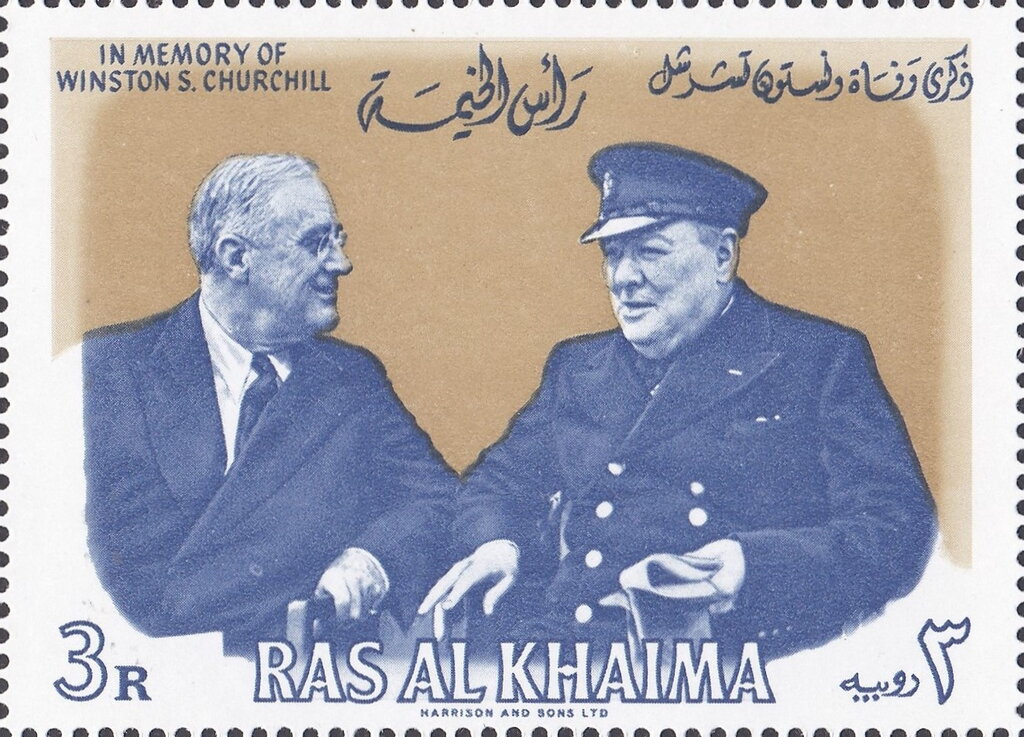
Churchill and President Roosevelt - 3 rupee
Following the death of Sir Winston Churchill on January 24, 1965, a state funeral (Operation Hope Not) was held in London six days later, marking one of the largest gatherings of world statesmen and heads of state in history. Celebrated globally as Great Britain's wartime Prime Minister who led the Allied nations through the Second World War, Churchill's leadership and parliamentary legacy left an indelible mark on 20th-century history.
Early Life & Rise to Prominence
Born into the aristocratic Spencer-Churchill family at Blenheim Palace, Sir Winston Leonard Spencer Churchill (1874–1965) began his career as a British Army officer and war correspondent. His adventurous exploits—most notably a daring escape from a Boer prisoner-of-war camp in South Africa—made him a household name before entering Parliament in 1900. Over the following decades, he held numerous key cabinet posts, including First Lord of the Admiralty and Chancellor of the Exchequer, while establishing himself as a prolific historian and author.
Wartime Leadership & Geopolitical Impact
Churchill’s defining role came on May 10, 1940, when he was appointed Prime Minister at the height of World War II. Resolutely opposing Nazi expansionism when much of Europe had fallen, he rallied the British public and Commonwealth through iconic speeches and steadfast leadership. Working alongside Allied partners Franklin D. Roosevelt and Joseph Stalin, Churchill orchestrated grand military strategy and post-war planning, securing victory for the Allies in 1945.
Post-War Career, Honors & Funeral
Returning for a second term as Prime Minister from 1951 to 1955, Churchill continued to influence international relations, famously coining the phrase "Iron Curtain" to describe Cold War divisions. In 1953, he was awarded the Nobel Prize in Literature for his historical writings and later became the first person proclaimed an Honorary Citizen of the United States. Following his death on January 24, 1965, Britain honored him with a monumental state funeral at St. Paul's Cathedral—attended by heads of state and representatives from over 110 countries—before he was laid to rest in Bladon.
Early Life & Rise to Prominence
Born into the aristocratic Spencer-Churchill family at Blenheim Palace, Sir Winston Leonard Spencer Churchill (1874–1965) began his career as a British Army officer and war correspondent. His adventurous exploits—most notably a daring escape from a Boer prisoner-of-war camp in South Africa—made him a household name before entering Parliament in 1900. Over the following decades, he held numerous key cabinet posts, including First Lord of the Admiralty and Chancellor of the Exchequer, while establishing himself as a prolific historian and author.
Wartime Leadership & Geopolitical Impact
Churchill’s defining role came on May 10, 1940, when he was appointed Prime Minister at the height of World War II. Resolutely opposing Nazi expansionism when much of Europe had fallen, he rallied the British public and Commonwealth through iconic speeches and steadfast leadership. Working alongside Allied partners Franklin D. Roosevelt and Joseph Stalin, Churchill orchestrated grand military strategy and post-war planning, securing victory for the Allies in 1945.
Post-War Career, Honors & Funeral
Returning for a second term as Prime Minister from 1951 to 1955, Churchill continued to influence international relations, famously coining the phrase "Iron Curtain" to describe Cold War divisions. In 1953, he was awarded the Nobel Prize in Literature for his historical writings and later became the first person proclaimed an Honorary Citizen of the United States. Following his death on January 24, 1965, Britain honored him with a monumental state funeral at St. Paul's Cathedral—attended by heads of state and representatives from over 110 countries—before he was laid to rest in Bladon.